
From Lab to Mud—Building Blocks, Integration, and the Architecture of Self-Sustainment

By Clive Morgan and Steve Green
Having explored the strategic realities of constant competition and dual-use supply chains, Steve Green and Clive Morgan now turn their attention to the operational edge. In this third installment, we examine the evolution of sustainment in extreme environments—and how the Self-Sustaining Force (SSF) concept moves military capability beyond reliance on vulnerable, continuous resupply lines
The history of military power may not be determined solely by what a force can destroy; it may be determined by how long it can sustain itself. For over a century, military planners have focused on improving the tactical edge of combat forces through better platforms, more advanced weapons, and increasingly sophisticated sensors. Yet history repeatedly teaches a different lesson: armies do not stop fighting because they run out of courage; they stop fighting because they run out of food, water, fuel, spare parts, and the structural ability to sustain operations. Logistics has always determined strategy.
Today, however, the logistics environment itself is undergoing a tectonic shift. Near-peer competition is placing unprecedented pressure on sustainment systems designed for an era of uncontested logistics, while climate impacts and expanding global footprints demand completely new operating realities. Nowhere is this challenge starker than in Canada’s North. The Arctic presents one of the most demanding logistics environments on Earth, where extreme distances drive costs, unpredictable weather drives tactical risk, and severely limited infrastructure means traditional resupply windows are drastically constrained. Traditional logistics models assume continuous external support; a future force can no longer rely on that assumption.
Against this backdrop, Canada has a profound opportunity to rethink military sustainment from first principles. That opportunity is the Self-Sustaining Force (SSF).
Pioneering initiatives within the Canadian Armed Forces (CAF), such as the Innovation for Defence Excellence and Security (IDEaS) Pop Up City challenge, have already laid the groundwork for this revolution. Rather than treating energy, water, and waste management as isolated engineering problems, the program demonstrated forward-thinking foresight: it proved that diverse clean-tech building blocks could be integrated into a unified containerised solution, managed by an intelligent management software designed to dynamically optimise the system.
As the program moves toward its highly anticipated Phase 4 deployment trials, it has provided Defence planners with a mature foundation for further development. To scale these breakthroughs from a verified prototype to an enduring, mission-ready capability that spans across remote Arctic radar sites, Forward Operating Locations, and joint logistics hubs, we must formalize the core pillars of self-sufficiency: standardized modularisation, tactical ruggedisation, extreme circularity, open architectures, and seamless information exchange.
The Building Blocks of Interoperability
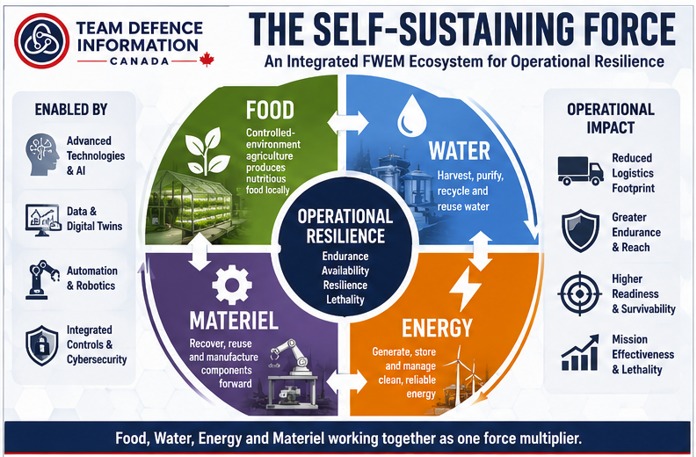
Traditional military logistics treats critical resources as separate functions—managing food, water, energy, and materiel independently through siloed supply chains, storage environments, and transport networks. The result is an infrastructure entirely dependent on constant external inputs. The SSF concept fundamentally challenges this model by treating Food, Energy, Water, and Materiel (FWEM) as a single, highly integrated ecosystem where every resource stream supports, consumes, and feeds the others.
This interoperability requires a standardised library of modular physical components. The goal of modularisation is to ensure that a containerised vertical farming unit, an atmospheric water generator (AWG), a greywater recovery kit, or a waste-to-energy processor all share the exact same physical and logical interfaces. By utilising standard ISO container footprints and universal structural connections, these systems can be mixed, matched, and scaled rapidly depending on the mission profile—whether setting up a 250-person forward operating location in the High Arctic or a 1,500-person Relocatable Temporary Camp (RTC) for an expeditionary task force.
However, commercial-off-the-shelf (COTS) technologies are rarely built to survive the unforgiving environments the military calls home. Ruggedization is the essential bridge between commercial excellence and operational survival. Frontend utility blocks must be hardened to withstand extreme thermal variations, severe transport vibrations, salt-fog corrosion, and stringent electromagnetic signature controls, all without sacrificing their volumetric efficiency.
From Scrap to Feedstock: Extreme Circularity
To truly detach from the constraints of long supply lines, our understanding of tactical circularity must look beyond camp plastics and greywater. We must treat our forward deployment footprint as a proactive resource asset. Every kilogram of food produced forward, every litre of water recovered, and every unit of energy generated locally directly translates into an asymmetric military advantage.
When an item of machinery, a vehicle component, or an electronics assembly reaches its End-of-Life (EOL) or is classified as Beyond Economic Repair (BER), it should no longer be abandoned, buried, or transported back across contested lines as dead-weight cargo. Instead, a self-sustaining force looks at its scrap heaps as local, strategic mines.
By integrating specialised processing building blocks into our forward infrastructure, deployed units can harvest critical raw materials—including rare earth elements, copper, high-grade aluminium, and titanium alloys—directly from Defence waste. This onsite refinement processes obsolete equipment back into premium raw feedstock, fuelling advanced additive manufacturing nodes directly at the tactical edge.
Architecture and Information Exchange: The Digital Backbone
While physical modularity allows you to stack components together, it is the underlying system architecture and information exchange that transforms a collection of hardware into a self-balancing ecosystem. As these systems become more automated and intelligent, the focus of logistics undergoes a fundamental shift.
The digital backbone is not merely an updated Maintenance, Repair, and Overhaul (MRO) tool for logging equipment failures; it is a real-time command-and-control engine designed to dynamically balance supply and demand variations across the entire Food, Energy, Water, and Materiel (FEWM) loop simultaneously.
By leveraging Machine Learning (ML), edge computing, and real-time sensor networks, camp infrastructure actively manages resource trade-offs. For example, if automated sensors note a drop in microgrid energy storage due to low solar yield, the system doesn’t just issue a warning—it dynamically down-regulates energy demand from secondary loops, temporarily dimming the LED arrays in a vertical farming container (Food) or adjusting the cycle times on an atmospheric water generator (Water) to protect the core camp power grid. Conversely, when greywater filtration yields are high, the architecture automatically reallocates that water supply to support localised hydroponics or advanced manufacturing feedstock production, constantly tuning the ecosystem to minimise waste and external resource dependencies.
This intelligent balancing acts as the proactive trigger for localised production. When embedded ML algorithms continuously assess equipment wear and environmental strain, they predict component degradation before an operational failure occurs. Once a threshold is crossed, the system recalculates the camp’s immediate resource balances, automatically calls upon the secure digital backbone to retrieve the certified print-design documentation, and schedules the build. The component is queued and printed using localised feedstock recovered from the camp’s own recycled Defence waste.
In this architecture, we are no longer distributing material; we are distributing data. Bytes replace bulk cargo, and secure code replaces the vulnerability of the physical supply convoy.
Operationalising the Blueprint
By framing self-sufficiency around these structured architecture requirements, the insights gained from the Pop-Up City program can be cleanly used to accelerate major capital procurement tracks currently on the CAF blueprint:
- DCB 000305 (Camp Sustain): The formal authority pipeline to field integrated camp utilities for large-scale deployed forces. Infusing this program with a standardised, open-architecture mandate ensures that future relocatable infrastructure is inherently interoperable and ready to absorb emerging technologies.
- Advanced Water Supply System: Leveraging modular purification and atmospheric generation blocks to systematically replace legacy, high-signature bulk water transport networks.
- Tactical Power System: Transitioning the generator modernisation fleet toward highly flexible, multi-fuel microgrids and clean-energy storage blocks that communicate natively with camp utility loops.
- DND/ISC & NRC Advanced Manufacturing Frameworks: Integrating current activities in Advanced and Additive Manufacturing (AdM)—such as smart toolpath virtualisation, metallic/composite 3D printing, and automated material reclamation—directly into the frontline sustainment architecture. This ensures that field-deployed 3D printing nodes operate on verified, high-agility processes matured by national research hubs.
A Collaborative Blueprint for Industry and Academia
This systemic approach changes the nature of cross-sector engagement. Canada already possesses world-class capabilities across clean technology, artificial intelligence, controlled-environment agriculture, advanced manufacturing, and resource recovery. The defining challenge of the coming decades is not innovation; it is integration.
For industry primes, clean-tech innovators, and academic researchers, the directive from DND must be clear: design for the architecture, not for the silo. By engaging with sector partners right at the inception of options analysis, the CAF can establish the open physical and digital standards required for long-term capability acceleration. This enables Defence procurement to systematically Adopt mature commercial building blocks, Adapt and ruggedize them for tactical environments, and reserve expensive, military-Bespoke development exclusively for specialized operational requirements.
The exceptional work done to date on the Pop-Up City challenge has proven what is possible when we think innovatively about sustainment. By codifying these breakthroughs into an integrated, ruggedised, and open System-of-Systems, the CAF will continue to lead the way—turning tactical logistics from a vulnerable dependency into a resilient operational advantage. The nations that solve this resilience challenge first will gain a significant strategic advantage. The future force will not simply be better supplied; it will increasingly supply itself.
Follow Team Defence Information Canada on LinkedIn, Subscribe to our webpage to receive upadtes or even email the authors using the images below